Behavioral Story 1
Technical disagreement (Playwright / chart validation)
1
Pushed back on a technical decision — then tested my own assumption and changed my mind
Team lead proposed Playwright for chart validation. I was skeptical about latency. I built a POC, proved myself wrong, and we shipped it. Dashboard usage doubled.
VisGuard architecture
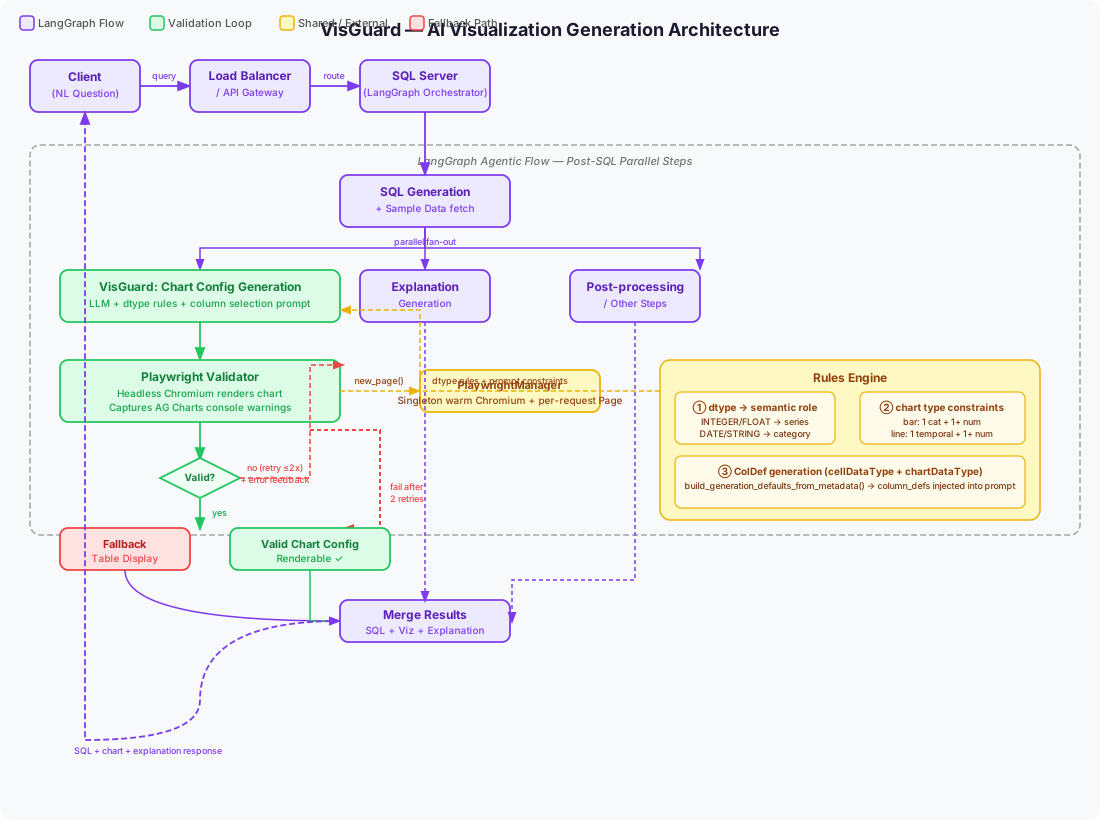
S — Situation
Building a visualization generation feature. Team lead proposed using a headless Playwright instance to validate AI-generated chart configs before serving them to users.
T — Task
I was skeptical — spinning up a headless Chromium instance per request felt like it would introduce unacceptable latency. Rather than just pushing back verbally, I needed to validate or disprove my concern with real data.
A — Action
Researched Playwright's architecture, then built a POC: rendered AG Charts inside headless Chromium with mock data and measured actual latency. Found it was acceptable — our workflow is async, users already expect a wait, and a broken chart damages trust far more than a slightly longer load. Brought findings back to the team and acknowledged my initial concern didn't hold up.
R — Result
Team moved forward with Playwright. After shipping, dashboard usage increased ~100% alongside the AG Charts integration. This recalibrated my framework: when broken is worse than slow, reliability wins.
~100% dashboard usage increasemental model updated
90-second version — ready to say out loud
"We were building a visualization generation feature, and my team lead proposed using a headless Playwright instance to validate AI-generated chart configurations before they reached the user. My initial reaction was skepticism — I was worried that spinning up a headless Chromium instance per request would add unacceptable latency and hurt the user experience.
But rather than just pushing back in the discussion, I decided to actually test my assumption. I dug into the Playwright architecture and built a small POC — rendered AG Charts inside headless Chromium with mock data and measured the real latency numbers.
What I found was that my concern didn't hold up. The latency was acceptable. And when I thought about it more carefully — our workflow is already async, users have a built-in wait expectation, and a broken or invalid chart damages user trust far more than a slightly longer load time. Reliability had to win over raw speed.
I brought the findings back to the team, acknowledged I was wrong, and we moved forward with Playwright. After shipping, dashboard usage increased roughly 100%. The bigger takeaway for me was a recalibrated framework: when a broken result is worse than a slow one, optimize for reliability first."
But rather than just pushing back in the discussion, I decided to actually test my assumption. I dug into the Playwright architecture and built a small POC — rendered AG Charts inside headless Chromium with mock data and measured the real latency numbers.
What I found was that my concern didn't hold up. The latency was acceptable. And when I thought about it more carefully — our workflow is already async, users have a built-in wait expectation, and a broken or invalid chart damages user trust far more than a slightly longer load time. Reliability had to win over raw speed.
I brought the findings back to the team, acknowledged I was wrong, and we moved forward with Playwright. After shipping, dashboard usage increased roughly 100%. The bigger takeaway for me was a recalibrated framework: when a broken result is worse than a slow one, optimize for reliability first."
"Disagreed with a technical decision"
Lead with: skepticism → POC → changed mind
Primary question — use the script above directly
"Tell me about a time you changed your mind"
Lead with: I was wrong — here's how I found out
Open with "I had a strong initial instinct that turned out to be wrong"
"Technical tradeoffs / decision under uncertainty"
Lead with: reliability vs latency framework
End on the principle — when broken = worse than slow, reliability wins
"Taking initiative"
Lead with: built the POC without being asked
Nobody told you to test it — you resolved the uncertainty yourself